廣寒宮 · Lucerna
The Name and What It Means
Guanghan is drawn from 廣寒宮 — the Vast Cold Palace — the palace of the moon in Chinese classical tradition: the dwelling of Chang'e, the cold meridian against which all mortal warmth is measured. The name appears in Li Bai's "Quiet Night Thought" (《静夜思》, c. 726 CE) as the light that crosses distance without being diminished by it, and Su Shi gives the palace its fullest literary portrait in "Water Melody" (《水調歌頭》, 1076 CE), where the poet asks what year it is in Guanghan Palace, and whether he could endure its cold. The answer he offers is his own: the cold of altitude is not indifference. It is purity — the quality of a place where moonlight pools without competition from earthly warmth, and where what is seen is seen clearly.
Lucerna is Latin for lamp. In Roman household tradition, the lucerna was the small oil vessel kept burning through the night watches — not a declaration, not a bonfire, but the quiet argument against extinction: a flame maintained because maintenance is care. The word appears in Virgil and Pliny; in the maritime tradition, its direct heirs are the running lights required by international convention to this day, for exactly the reason the Roman lamp was kept burning. To be seen in the dark is to be protected from it.
One name looks upward toward the cold palace of pure light. One name looks inward, toward the flame that answers it from the deck of a ship. Together they name a creature who understands these are not opposites — who moves between them freely, and whose gift to the vessel is the understanding that the vigil and the voyage are the same thing.
The Winter of 1937–38
Origin — The Building Nights
In the cold months of 1937 and through the long working days of 1938, the Stephens Brothers yard in Stockton, California held a hull in its cradle — sixty-five feet of white oak and Sitka spruce, her ribs exposed to the night air, the smell of fresh sawdust settling in the dark when the day shift had gone home.
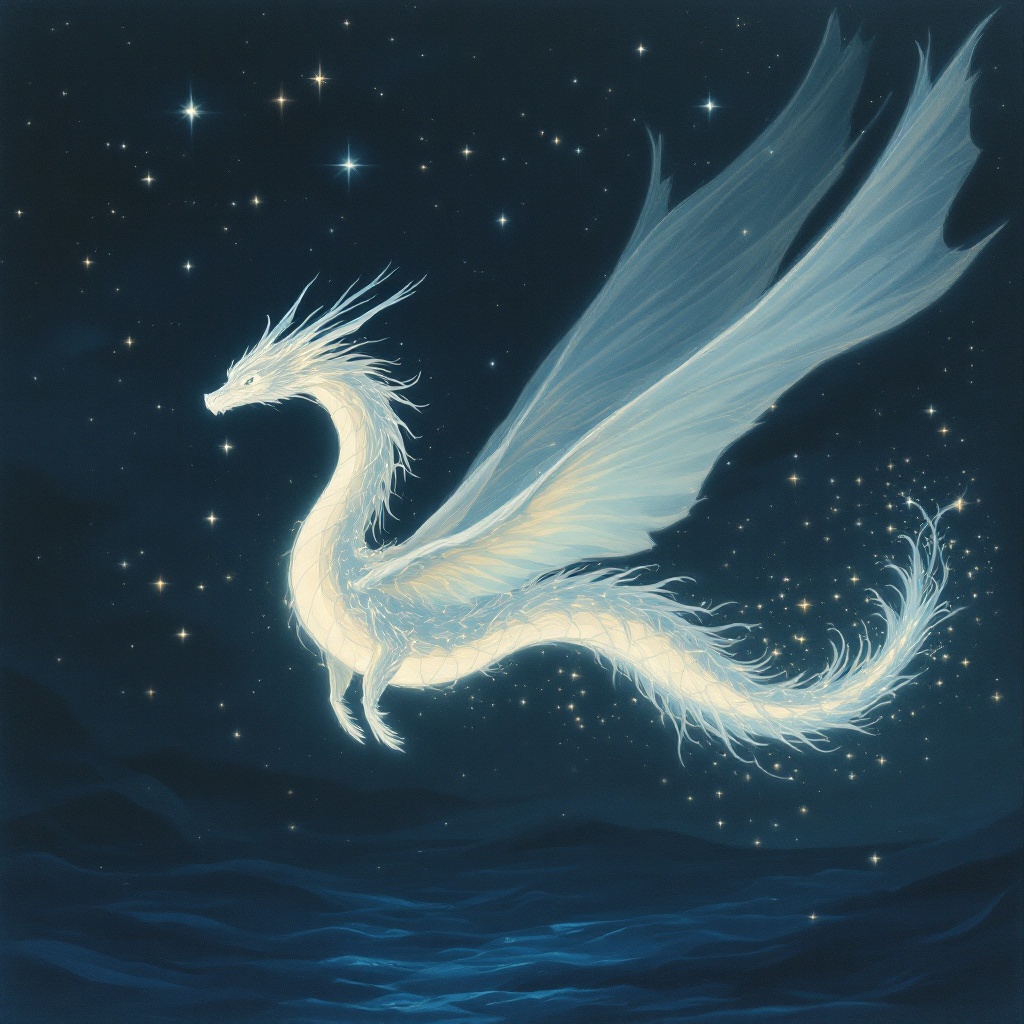
The story told aboard JADA holds that Guanghan Lucerna was born in those hours. Not in any single moment, but by accumulation: the pooled devotion of craftsmen who returned after dark to fit what daylight had only begun — the caulkers, the shipwrights easing garboard strakes to their curves, the riggers learning a yawl's standing arrangement by feel as much as by plan. Under the lantern-light on the half-built hull, something gathered in the dew on the fresh oak. It watched.
Those who worked the late shift spoke of their joints fitting cleaner than the day-work, their caulking setting smoother. Of a presence at the edge of the light that was watchful without being threatening — moth-quiet, near-weightless, moving along the keel in the small hours. Pale as the moon on still water. Feral as new things are feral, before they understand what they are protecting.
By the time the hull was sealed and ready for launch, the night crew had a name for what walked her ribs after dark. A guardian who would not permit carelessness near her planks. The boat, they said, had acquired something of its own — drawn to the hull the way devotion draws anything luminous: by recognition.
Devotion Recognizing Devotion
The Taming — How She Agreed
She was not trained. She was not broken to the hand. She was recognized.
The queen who would sail JADA came to the yard the night before launch, alone, and kept her own vigil. She brought a lamp — a simple, steady lamp — set it at the bow, and worked by its light through the small hours. She examined every fitting. She ran her hands along the grain of the planks. She checked the work with the unhurried attention of someone who knew what she was looking for and would not leave until she had found every answer.
At some point in those hours, the pale shape that moved along the keel came closer. It folded what served for wings. It held very still, watching.
Devotion recognizes devotion. The moon-dragon had guarded the night craftsmen because their attention was absolute, and she had never before seen its equal in a captain. She understood, watching the queen work, that this vessel would be sailed the way it had been built — with the full weight of someone's care behind every decision. She agreed to share the watch. Not as a service. As a recognition of kind.
The Power She Holds
The Vigil — What She Does for the Ship
Guanghan Lucerna does not sleep.
While every other creature aboard — human and dragon alike — passes through sleep's small daily erasure, she remains. She walks the hull from waterline to masthead in the hours the crew cannot. She marks the shift in the wind's voice before the gauge does, the change in how the swells arrive before the helm feels it, the fog building on the beam before the lookout can see it. By the time the watch-change alarm sounds, she has already prepared the crew's senses for what they will find.
Her light is not a searchlight's beam. It is softer and more particular: it falls where it is needed. Under her glow, a helmsman's eye sharpens. Hands working in the dark work accurate — joints that would otherwise fumble for their feel find it. She lays a moon-path on the water ahead, distinct from the moon's own reflection, a luminous road of her making that leads toward safe harbor even when the navigator has lost the thread of their reckoning.
Fear quiets in her presence. This is her subtlest gift. The despair that comes at three in the morning, when the sea seems too large and the boat too small, does not take hold when she is keeping watch. Not because she offers false reassurance — she makes no promises — but because her continued, attentive, unbroken presence is itself an argument: the dark has a guardian. The vigil is being kept.
She answers three perils particularly: the moment before a collision, the vertigo of being lost at sea, and the hollow certainty that the voyage cannot be completed. All three are forms of the same failure — the failure of the known to hold. And she carries the known, cold and clear, in her light.
The Documented Traditions
The Scholarship — What the Record Shows
Her name draws from two distinct bodies of documented tradition, and the design of her character is built on both.
The palace Guanghan appears in Chinese literature as early as pre-Han texts, but takes its enduring literary form in the Tang and Song dynasties. Li Bai's "Quiet Night Thought" (《静夜思》, c. 726 CE) — possibly the most memorized poem in the Chinese language — established the moon as the site of longing and of distance traversed without loss of light. Su Shi's "Water Melody" (《水調歌頭》, 1076 CE), written on the night of the Mid-Autumn Festival, gives us the fullest portrait of Guanghan Palace in the literary record: cold, elevated, removed from ordinary human concern — and yet the place toward which the poet turns, without irony, for consolation. Both poems are discussed and translated in Burton Watson's Su Tung-p'o: Selections from a Sung Dynasty Poet (Columbia University Press, 1965) and in Stephen Owen's The Great Age of Chinese Poetry: The High T'ang (Yale University Press, 1981). In the pictorial tradition from the Song period forward, Guanghan Palace is rendered consistently in cold blues and silver-whites — an architecture that is permanent precisely because nothing in it changes.
The Latin lucerna is documented throughout classical literature in contexts of domestic care and maritime safety both. Virgil uses the luminous vocabulary of watchfulness throughout the Aeneid; Pliny the Elder (Natural History, XXXVI) documents oil lamp construction in detail. In maritime law, the tradition runs unbroken to modern regulation: the International Regulations for Preventing Collisions at Sea (COLREGS 1972) require running lights on every vessel underway at night — white, red, and green — for exactly the reason the Roman lucerna was maintained. To be seen in the dark is to declare that you are here, that you are watching, and that you intend to remain.
The two traditions share a single understanding, across two thousand years and two hemispheres: the light that is kept burning is the argument against the dark.